SHSM Certifications and ICE Training: The Complete Guide
SHSM certifications are one of the most searched and least understood components of Ontario’s Specialist High Skills Major program. If you coordinate an SHSM program and have ever searched for “ICE training SHSM,” you are not alone. Teachers, administrators, and board leads use the terms interchangeably, even though ICE and certifications are technically different parts of the program.
This guide covers everything Ontario educators need to know about SHSM certification and training requirements: compulsory and elective certifications for all 19 sectors, who can deliver them, how to bring in external providers, costs and funding, and virtual versus in-person delivery. Whether you are setting up a new SHSM program or refining your approach in year five, this is the reference you can bookmark and return to throughout the school year.
For a full overview of how SHSM works, including the credit bundle, Ontario Skills Passport, and reach-ahead components, see our guide to SHSM requirements.
What Are SHSM Certifications? (And Why “ICE Training” Is a Misnomer)
SHSM certifications are sector-recognized credentials that every student must earn as one of five required SHSM components. The Ontario Ministry of Education defines them as “Certification and Training Experiences” in the official SHSM Policy and Implementation Guide (updated October 2025). They are distinct from the credit bundle, Sector-Partnered Experiences (SPE), reach-ahead activities, and the Ontario Skills Passport.
So where does the term “ICE training” come from?
ICE officially stands for Innovation, Creativity and Entrepreneurship. According to the SHSM Policy and Implementation Guide, ICE is a structured activity within the Sector-Partnered Experiences (SPE) component, not the certification component. Every sector’s SPE description states that students engage with a sector partner to learn about the sector and how it connects with “ICE (innovation, creativity and entrepreneurship), coding and/or math literacy skills.”
Despite this official definition, the Ontario education market widely uses “ICE training” as shorthand for any SHSM workshop. That creates a persistent terminology gap: teachers search for “ICE training” when they sometimes need certification providers and sometimes need SPE partners. This guide uses both terms while clarifying the distinction.
Source: Ontario Ministry of Education, “Specialist High Skills Major Policy and Implementation Guide – Sector-Partnered Experiences” (ontario.ca/document/specialist-high-skills-major-shsm-policy-and-implementation-guide/sector-partnered).
Understanding this distinction matters for compliance. When your school board reports to the Ministry, certifications and SPE activities are tracked separately. A student who completes an ICE challenge at MaRS Discovery District is fulfilling an SPE requirement, not a certification requirement. A student who earns their Intermediate First Aid certificate, renamed from Standard First Aid in June 2026, is completing a certification, not an SPE.
It is also worth noting that no specific PPM governs SHSM. The program is governed entirely through the SHSM Policy and Implementation Guide, with PPM 76A referenced specifically for workplace safety and insurance coverage during experiential learning placements.
For the full breakdown of all five SHSM components, see our SHSM requirements guide.
Compulsory SHSM Certifications Every Student Must Earn
Three certifications are compulsory across virtually every SHSM sector. Every student, regardless of whether they are in Health and Wellness, Business, or Construction, must complete these before earning their SHSM designation.
The three core compulsory SHSM certifications are:
- CPR Level C with AED (Automated External Defibrillation): issued by the Canadian Red Cross, St. John Ambulance, or the Heart and Stroke Foundation
- Intermediate First Aid: typically delivered as a combined 16-hour course alongside CPR-C through the same issuing bodies
- WHMIS (Workplace Hazardous Materials Information System): generic, not site-specific instruction, and does not require a certified trainer per Ministry policy. WHMIS can be teacher-delivered or completed through an online platform. The generic form is the one SHSM requires; see the two types of WHMIS training and which one SHSM needs.
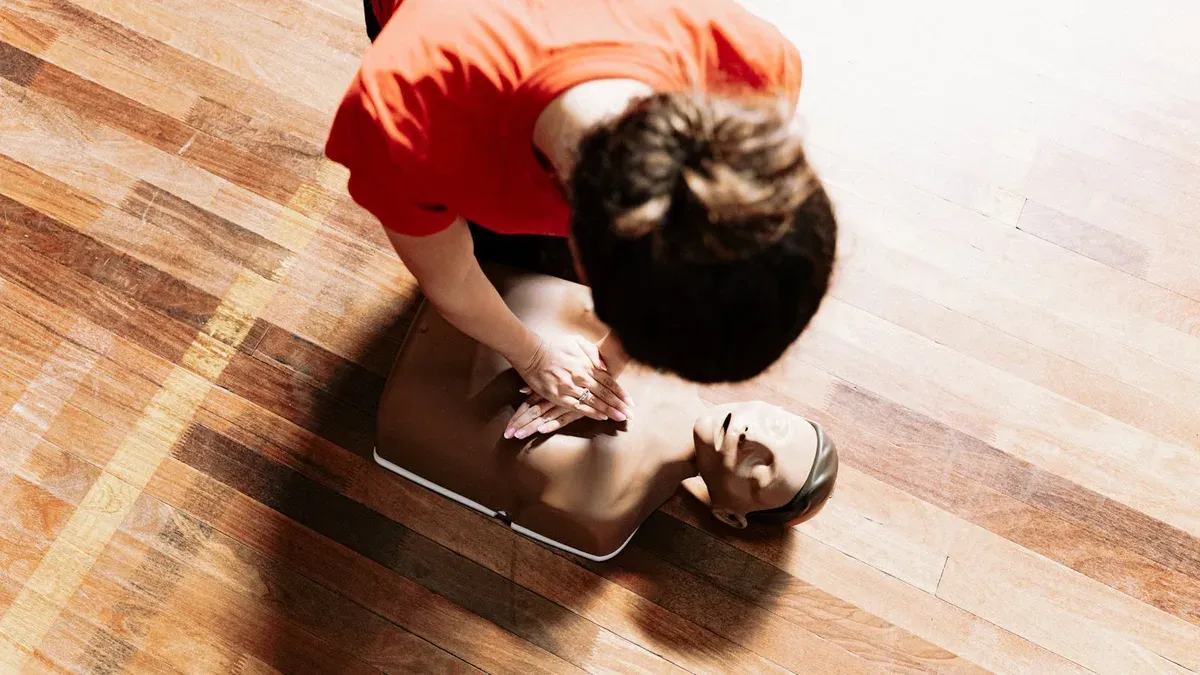
In our experience delivering certification workshops across Ontario, the two-day format produces stronger retention than single-day compressed sessions. At Iona Catholic Secondary School (DPCDSB) in November 2025, LearnIt delivered a two-day CPR and first aid certification program where students transitioned from theoretical knowledge to confident practical application.
Beyond these three core certifications, several sectors require additional compulsory credentials:
- Construction requires Working at Heights and a Health and Safety Basic course (five compulsory total)
- Health and Wellness requires Infection Control (four compulsory total)
- Business requires Customer Service (four compulsory total)
- Hospitality and Tourism requires Customer Service training (four compulsory total); Food Handler Certification is its most-used elective
Source: Ontario Ministry of Education, “Specialist High Skills Major Policy and Implementation Guide – Certification and Training” (ontario.ca/document/specialist-high-skills-major-shsm-policy-and-implementation-guide/certification-and).
The total number of required SHSM certifications per student ranges from six to seven, depending on the sector. This includes compulsory and elective certifications combined. Certification validity periods vary:
- Intermediate First Aid with CPR-C: valid for three years
- WHMIS: no formal expiry
- Smart Serve: valid for five years (for certificates issued after July 1, 2018)
- Food Handler Certificate: valid for five years under Ontario regulation
- Working at Heights: valid for three years under O. Reg. 297/13
The Ministry guide does not address renewal. Certifications appear on the SHSM Record as completed regardless of later expiry, since the SHSM program itself spans only two years (Grades 11 and 12).
Compulsory Certifications by Sector
| Sector | Compulsory Certifications | Total Compulsory |
|---|---|---|
| Arts and Culture | CPR-C with AED, Intermediate First Aid, WHMIS | 3 |
| Business | CPR-C with AED, Intermediate First Aid, WHMIS, Customer Service | 4 |
| Construction | CPR-C with AED, Intermediate First Aid, WHMIS, Working at Heights, Health and Safety Basic | 5 |
| Environment | CPR-C with AED, Intermediate First Aid, WHMIS, Compass, map and GPS awareness | 4 |
| Health and Wellness | CPR-C with AED, Intermediate First Aid, WHMIS, Infection Control | 4 |
| Hospitality and Tourism | CPR-C with AED, Intermediate First Aid, WHMIS, Customer Service | 4 |
| ICT | CPR-C with AED, Intermediate First Aid, WHMIS | 3 |
| Manufacturing | CPR-C with AED, Intermediate First Aid, WHMIS | 3 |
| Sports | CPR-C with AED, Intermediate First Aid, WHMIS | 3 |
Source: Compiled from individual sector pages of the Ontario Ministry of Education SHSM Policy and Implementation Guide (ontario.ca/document/specialist-high-skills-major-shsm-policy-and-implementation-guide/sectors). Verified against current Ministry content in Spring 2026; the table covers nine of the 19 sectors, not the full Ministry list; the compulsory lists were re-read against the sector pages on 2026-09-07.
This is the first publicly available table consolidating compulsory SHSM certifications across sectors. Previously, coordinators had to visit each of the 19 individual sector pages on Ontario.ca to piece this information together.
For more on SHSM requirements and how certifications fit into the broader program, see our pillar guide.
Sector-Specific Elective Certifications: The Complete List
Beyond compulsory certifications, every SHSM student must also complete elective certifications chosen from a Ministry-approved list. The Ministry prescribes a defined set of elective options for each sector. Schools may not substitute other programs for the certifications listed, and they may not reduce the required number.
SHSM elective certifications follow a specific Ministry framework. The SHSM Policy and Implementation Guide prescribes a defined list of approved elective options for each of the 19 sectors, and schools may not substitute alternative programs. The naming convention matters:
- Items listed in UPPERCASE (such as WHMIS, SMART SERVE) are proper names of specific certifications, meaning the exact named program must be used.
- Items listed in lowercase (such as “leadership skills” or “communication skills”) are categories of training where the school board selects the specific program.
In exceptional circumstances, a principal may substitute a compulsory certification with an approved sector-specific elective certification on a case-by-case basis. The number of elective certifications required varies by sector, typically ranging from two to three. School boards can also propose additional certifications for Ministry review and potential inclusion in the approved list, though this process is not commonly used.
Source: Ontario Ministry of Education, “Specialist High Skills Major Policy and Implementation Guide – Certification and Training” (ontario.ca/document/specialist-high-skills-major-shsm-policy-and-implementation-guide/certification-and).
Below are the elective certification options for six of the most common SHSM sectors. Each list comes directly from the corresponding sector page in the SHSM Policy and Implementation Guide.
Elective Certification Options by Sector
Health and Wellness (choose 3 elective): Mental Health First Aid, allergy awareness, babysitting, communication skills, conflict resolution, customer service, dietary considerations, fitness, leadership skills, medical terminology, non-violent crisis intervention, personal training, project management, sign language, stress management techniques, specialized care (diabetes, dementia, nutrition), ambulation/lifting and transfers, sterile techniques, lab practices, behaviour management, wrapping and taping, portfolio development, anti-oppression and allyship training, and 40+ additional options.
Business (choose 2 elective): Communication skills, conflict resolution, event management, financial literacy, leadership skills, marketing, project management, public speaking, social media, specialized business program or competition (DECA, Junior Achievement, Stock Market Competition, Make Your Pitch, Summer Company Program).
ICT (choose 3 elective): Advanced training in a technique (website design, coding, digital lighting, SEO), cyber-security training, customer service, leadership skills, portfolio development, project management, social media.
Construction (choose 2 elective): Confined space awareness, fall arrest, fire safety and fire extinguisher use, ladder safety, lockout/tag-out, PPE training, scaffolding, trench awareness, welding (advanced training in a technique).
Arts and Culture (choose 3 elective): Advanced training in a technique (figure drawing, conducting, sewing), 3D printing, customer service, event management, leadership skills, portfolio development, public speaking, social media, stage management.
Hospitality and Tourism (choose 2 elective): Smart Serve, event management, communication skills, customer service, conflict resolution, leadership skills, portfolio development, public speaking, social media.
Source: Individual sector pages of the Ontario Ministry of Education SHSM Policy and Implementation Guide (ontario.ca/document/specialist-high-skills-major-shsm-policy-and-implementation-guide/sectors).
For deeper coverage of Health and Wellness certifications, including what boards actually deliver and which electives are most popular, see our SHSM Health and Wellness guide. Similar deep-dive guides for other sectors are in development.
Who Can Deliver SHSM Certification Training?
The Ministry approves four delivery models for SHSM certification training. Understanding all four helps coordinators build flexible, cost-effective programs. The Guide’s own advantages and disadvantages for each model, and the rules that apply to all four, are reproduced in Four ways to deliver an SHSM certification.
The SHSM Policy and Implementation Guide identifies four approved delivery models:
- Industry-delivered training from external workshop companies such as LearnIt and a small handful of other specialized Ontario providers. These providers bring current, sector-recognized, hands-on training directly to schools or off-site venues.
- Online training platforms including WHMIS online providers, Smart Serve Ontario, and FoodSafetyMarket for Food Handler certification. These are accessible and cost-effective but lack hands-on components.
- Co-delivered programs with sector and education partners, such as university-led workshops, conservation-authority field days, or industry-hosted experiences. These are differentiated for learner needs and foster ongoing partnerships.
- Teacher-delivered training through a “train the trainer” model where school board staff become certified to deliver specific programs. This is the most cost-effective and sustainable approach but may lack the sector exposure that external professionals bring to the classroom.
Source: Ontario Ministry of Education, “Specialist High Skills Major Policy and Implementation Guide – Certification and Training” (ontario.ca/document/specialist-high-skills-major-shsm-policy-and-implementation-guide/certification-and).
Beyond these four models, additional delivery categories include:
- Industry associations and regulatory bodies such as the Canadian Red Cross and St. John Ambulance, which operates 27 offices across Ontario
- Smart Serve Ontario, the only AGCO-approved program
- Public health units for Food Handler certification
- College partnerships through dual credit programs
A directory maintained jointly by the Ontario Catholic School Trustees’ Association and the Ontario Public School Boards’ Association lists 25+ approved SHSM providers, categorized by delivery mode (Live, Virtual Facilitated, Virtual Recorded). Coordinators typically discover new providers through that directory, colleague recommendations, and board-level SHSM networks.
Ministry requirements for any provider include:
- A certified trainer recognized as an authority by the certification provider or sector (with the exception of WHMIS, which does not require a certified trainer)
- An assessment and evaluation component
- Documentation for the student portfolio and SHSM record
- Recorded hours and completion dates for the student management system
How to Bring an External Provider Into Your School
Bringing in an external provider to deliver SHSM certifications follows a typical process, though specific requirements vary by board.
- The SHSM coordinator or board SHSM lead identifies certification needs for the academic year.
- Providers are discovered through the OCSTA / OPSBA joint SHSM directory, colleague recommendations, or direct outreach.
- The provider must demonstrate: certified trainers with appropriate credentials, commercial general liability insurance ($2M or more), and Vulnerable Sector Check compliance.
- Ontario Regulation 521/01 under the Education Act mandates criminal background checks, including Vulnerable Sector Checks (VSC), for all service providers with direct student contact. Updated regulations (O. Reg. 298/25, filed December 5, 2025, along with companion O. Reg. 289/25, 290/25, and 291/25) adopted the “police record check” and “vulnerable sector check” terminology from the Police Record Checks Reform Act, 2015. The new rules also introduced staggered re-check deadlines through 2026 and 2027.
- For purchases under $100,000, many school boards bypass formal procurement processes. Larger contracts may require a formal RFP through platforms such as Bids and Tenders.
- SHSM budgets, which are Ministry-funded, cover certification costs. Booking is arranged directly between the teacher or school and the provider.
- The provider delivers the session (in-school, off-site, or virtual), provides certificates and documentation, and the school records completion in the student management system.
Source: Procurement threshold and RFP practice from YCDSB Purchasing Services, “How to do business with the YCDSB” (ycdsb.ca/about/departments/purchasing-services/how-to-do-business-with-the-ycdsb/). Vulnerable Sector Check regulatory overhaul (O. Reg. 298/25 and companions 289/25, 290/25, 291/25) from Hicks Morley LLP, “Ontario Overhauls Background Checks For School Board Personnel” (hicksmorley.com/2025/12/12/ontario-overhauls-background-checks-for-school-board-personnel/).
No public guide previously existed explaining this step-by-step process for bringing external training providers into Ontario schools for SHSM delivery.
LearnIt delivers SHSM certification workshops across 20+ Ontario school boards, including in-school, off-site, and virtual formats. For a full workshop catalogue and booking details, visit learn-it.ca/events.
How Much Do SHSM Certifications Cost? (And How They Are Funded)
Understanding the cost structure of SHSM certifications helps coordinators plan budgets more effectively and advocate for adequate funding from their school board.
SHSM certification costs vary significantly by type and delivery model:
- Intermediate First Aid with CPR-C: $100 to $150 at retail rates, with group rates typically $50 to $80 per student for a 16-hour course
- WHMIS: no published price; can be teacher-delivered
- Smart Serve: $44.95 for the full online course
- Food Handler certification: $25 to $40
- Working at Heights: approximately $150 to $200 per student, must be delivered by a Ministry of Labour-approved provider
- Soft skill certifications (leadership, communication): $30 to $65 per student from group-rate providers
Funding flows from the Ministry of Education to school boards as part of the broader education funding formula, then to individual schools and programs, and finally to certification providers. Under Ontario’s Core Education Funding model (2024–25 onward), SHSM is supported through the “Continuing Education and Other Programs Allocation” within the Learning Resources Fund. The most recent publicly-disclosed SHSM-specific expansion figure (Priorities and Partnerships Fund, $12 million in 2021–22) remains the only disaggregated number available.
Source: Financial Accountability Office of Ontario, “School Boards’ Compliance with the Ministry of Education’s Funding Policies” (fao-on.org/en/report/fa2207schoolboards/, 2022 report). Current funding framework from Ontario Ministry of Education, “A Guide to Core Education Funding 2024–25” (ontario.ca/files/2024-09/edu-a-guide-to-core-education-funding-24-25-en-2024-09-20.pdf).
For students, the cost is typically zero. The Greater Essex County District School Board states clearly: “There is NO COST for students to participate in this program.” The Waterloo Catholic District School Board notes that “Only the first attempt at these courses will be paid for by SHSM,” indicating that boards absorb certification costs from their SHSM allocations.
Exact per-student or per-program allocations by individual boards are not publicly available, which remains a source of confusion for many coordinators navigating budget season.
Certification Cost Comparison
| Certification | Typical Cost Per Student | Duration | Delivery Format |
|---|---|---|---|
| Intermediate First Aid with CPR-C | $50 to $80 (group rate) | 16 hours (2 days) | In-person or blended |
| WHMIS | No price published by Ontario or CCOHS; Ontario describes the CCOHS online course as available “for a small fee” | Not published | Online or teacher-delivered |
| Smart Serve | $44.95 | Self-paced (online) | Online only |
| Food Handler Certificate | $25 to $40 | 6 to 8 hours | Online or in-person |
| Working at Heights | $150 to $200 | 8 hours (1 day) | In-person only (MOL-approved) |
| Soft skill certifications (leadership, communication) | $30 to $65 | Half-day to full-day | In-school, off-site, or virtual |
| ICE/SPE experiences | $65 to $120 | Full-day | Off-site or virtual |
Source: Smart Serve fee from Smart Serve Ontario pricing FAQ (smartservehelp.zendesk.com/hc/en-us/articles/4411411318413-How-much-does-it-cost). Soft-skill and SPE workshop pricing ranges compiled from Ontario SHSM workshop providers including LearnIt (learn-it.ca/events); retail First Aid / CPR and Working at Heights figures from Red Cross and Ministry-of-Labour-approved provider rate cards.
Virtual vs. In-Person Delivery: What Is Permitted Post-COVID?
Both virtual and in-person delivery are permitted for SHSM certifications, with the Ministry’s updated Policy and Implementation Guide listing “Online training” as one of four standard delivery models. Hybrid delivery has become standard practice across Ontario since the pandemic.
During lockdowns, the Ministry allowed students to earn their SHSM designation without completing the mandatory CPR and First Aid certification through an override process. St. John Ambulance Ontario documented this policy. Students who were unable to complete their SHSM requirements, including CPR/First Aid, could have the override process used to grant the SHSM designation without those certifications.
Post-COVID, hybrid delivery is the new normal. Most providers listed in the OCSTA / OPSBA joint SHSM directory offer at least two delivery modes. Blended models have emerged for hands-on certifications, combining online theory with in-person practical sessions. Established issuing bodies like St. John Ambulance now offer this hybrid approach for First Aid training. LearnIt runs in-school, off-site, and fully virtual certification workshops across Ontario boards using the same blended pattern.
The SHSM Policy and Implementation Guide (republished December 2024, updated October 2025) includes “Online training” as one of four standard delivery models, confirming that virtual certification delivery is now a permanent option, not a temporary pandemic accommodation.
Jermain Holness, the TDSB Program Support Facilitator for SHSM, observed that “students already have a virtual existence. They just jumped on, and they were excited, because they realized, wow, I can be in my living room, and complete a certification.” Holness has stated he does not see the board moving away from virtual delivery.
Source: Jermain Holness quote and TDSB virtual-delivery observations from a published TDSB SHSM virtual-engagement case study (2024).
No specific Ministry policy document mandates which certifications must be delivered in-person versus virtually. This ambiguity gives coordinators flexibility, but it can also create uncertainty. When in doubt, verify with your board’s SHSM lead and check whether the certifying body (such as the Canadian Red Cross for First Aid) has its own delivery format requirements.
Tracking and Documentation: Recording Certifications in OnSIS
The Ministry requires that schools record every certification in the student management system, including the number of hours involved and the date each certification or training was completed. School boards must also record SHSM student names and completion of all five required SHSM components, including completion dates.
Source: Ontario Ministry of Education, “Specialist High Skills Major Policy and Implementation Guide – Documenting Student Progress” (ontario.ca/document/specialist-high-skills-major-shsm-policy-and-implementation-guide/documenting-student).
OnSIS submissions occur three times per year: October, March, and June. SHSM data is captured in specific segments within OnSIS. The SHSM Program segment is generated for students with SHSM certifications, and SHSM_CERTIFICATION child segments hold individual certification records. Key data fields include the SHSM Certification Date and the All Requirements Met Date.
Since June 2019, the system uses SHSM_CERTIFICATION elements, replacing the older SHSM_COURSE format. Coordinators working with older documentation or templates should verify they are using the current data structure.
The SHSM eCommunity at community.elearningontario.ca is a password-protected Ministry resource that provides additional educator materials for tracking and documentation (account required; request access via your board SHSM lead). Because it is gated, many new SHSM coordinators do not know these resources exist until they are granted access.
For a broader look at how certifications fit into the full set of SHSM requirements, see our requirements guide.
Common Challenges Teachers Face with SHSM Certification Training
Coordinating SHSM certifications is one of the most operationally complex parts of running an SHSM program. These challenges are real, and acknowledging them is the first step toward building better systems.
Scheduling complexity is the most frequently cited issue. A single Intermediate First Aid course takes 16 hours across two full school days. Multiply that across multiple SHSM sectors in one school, and the timetable disruption is significant. Coordinators must negotiate with subject teachers, secure coverage for missed classes, and accommodate students who are absent on training days.
Budget management is complicated by the lack of transparency. No published per-student funding formula exists for SHSM certifications. Coordinators often do not know their exact allocation until the school year is underway, making advance planning with providers difficult.
Provider selection involves evaluating 25+ providers listed in the OCSTA / OPSBA joint directory with no centralized quality ratings or peer reviews. Coordinators are typically advised to vet workshop providers on three points:
- Experience working with SHSM students specifically
- Credential and certification status of their trainers
- The actual delivery format rather than marketing language
Teacher burnout is a real concern. SHSM coordinators manage external partnerships, handle OnSIS recording, track six to seven certifications per student across their roster, and maintain SHSM plans alongside their regular teaching load. This administrative burden falls disproportionately on a small number of dedicated teachers. In LearnIt’s experience across 20+ Ontario boards, turnkey multi-certification workshop bundles and documentation-ready completion records materially reduce the coordinator load during peak certification windows.
New teacher onboarding is another gap. Some Ontario SHSM providers have produced free “SHSM 101”-style overview materials for teachers new to the program. The existence of these resources signals how widespread the onboarding challenge is across the province.
Virtual versus in-person decision-making remains complicated. Without explicit Ministry guidance on which certifications require in-person delivery, coordinators must make judgment calls that affect both student experience and compliance.
Equity and access vary dramatically across the province. Rural and northern schools have fewer provider options and often pay premium rates for travel. French-language schools face an even narrower selection of French-delivery certification partners, widening the access gap further.
Student pathway changes add another layer of complexity. If a student switches SHSM sectors partway through, certifications already completed may not transfer to the new sector’s requirements.
If you are weighing the overall value of the program against these challenges, see our guide on whether SHSM is worth it.
Conclusion: Building an Efficient SHSM Certification Program
SHSM certifications are a defined, Ministry-governed component of the Specialist High Skills Major program. They are not ad hoc, and they are not optional. The terminology confusion between “ICE training” and “certification training” is common, but it is manageable once you understand the split. ICE belongs to the SPE component, while certifications are their own distinct requirement.
The fundamentals are consistent across Ontario. Three core compulsory certifications (CPR-C with AED, Intermediate First Aid, and WHMIS) apply to virtually all sectors. Elective certifications offer flexibility, but only within the Ministry-approved lists for each sector. Multiple delivery models exist, from industry-delivered workshops to teacher-led training to online platforms. Virtual delivery is now a permanent, standard option.
Planning ahead makes the difference between a manageable certification schedule and a stressful scramble. Start identifying provider needs early, confirm your board’s SHSM funding allocation as soon as possible, and build a calendar that accounts for the two-day blocks required for First Aid training.
For students who complete all their SHSM certifications and program requirements, the accomplishment is recorded on their Ontario Student Transcript and recognized with a red seal on their diploma. Several Ontario universities and colleges also offer SHSM-specific scholarships that reward students who earn their designation.
For a full overview of how SHSM works, including all five program components, see our guide to what SHSM is.
LearnIt offers in-school, off-site, and virtual certification workshops across multiple SHSM sectors for Ontario school boards, with hands-on learning led by relatable mentors in their 20s and 30s. Explore the full workshop catalogue at learn-it.ca/events.